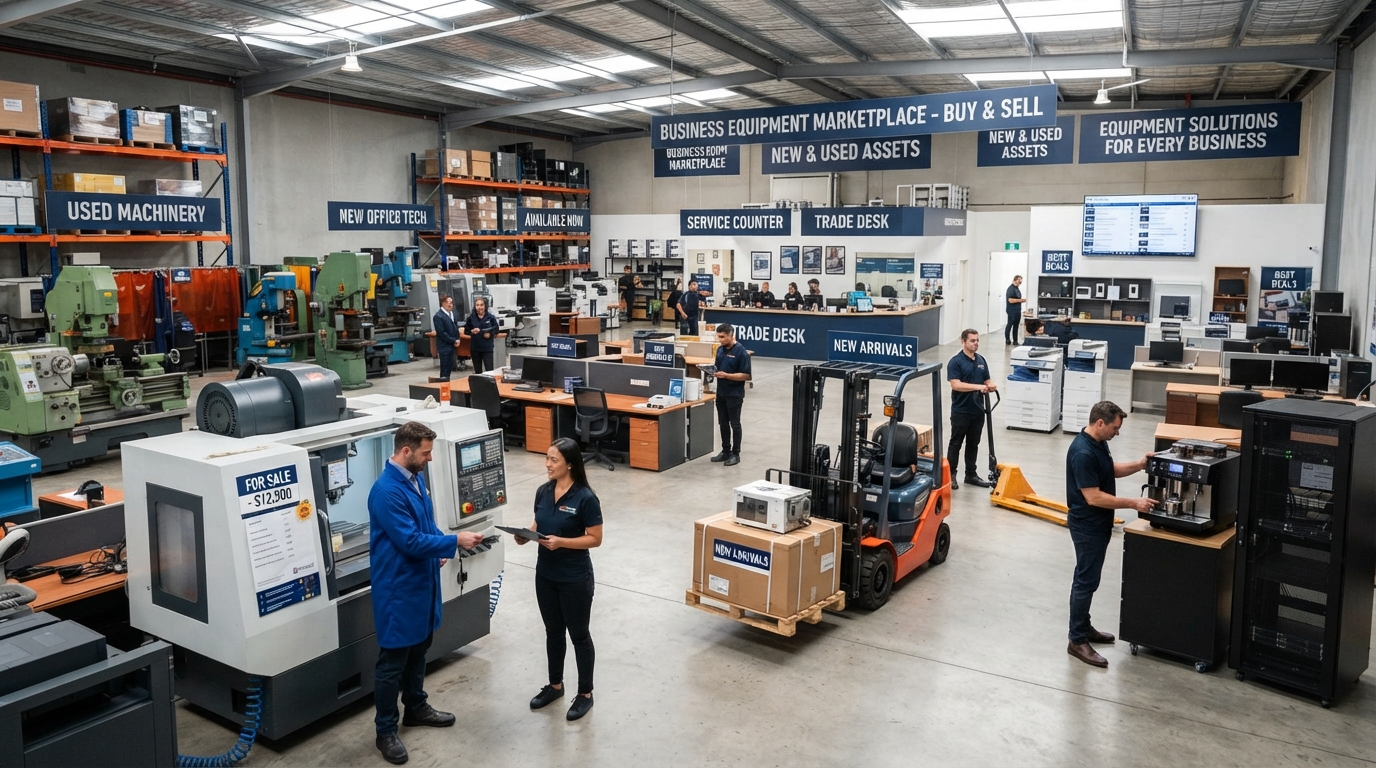
Starting, expanding, or upgrading a business often requires expensive equipment. From restaurant appliances and construction machinery to office furniture, manufacturing equipment, tools, and commercial vehicles, businesses need reliable equipment to operate efficiently. However, finding the right equipment at the right price can be difficult, especially when comparing multiple sellers and marketplaces.
A Business Equipment Marketplace provides a convenient way for business owners, entrepreneurs, contractors, retailers, manufacturers, and other professionals to buy and sell commercial equipment in one place.
Instead of searching through dozens of websites, local listings, classified ads, and individual suppliers, buyers can use a business equipment marketplace to discover equipment, compare prices, review specifications, contact sellers, and make informed purchasing decisions.
Whether you are looking for used business equipment, new commercial machinery, restaurant equipment, construction tools, office equipment, or industrial machinery, an online marketplace can make the buying process faster and more organized.
What Is a Business Equipment Marketplace?
A Business Equipment Marketplace is an online platform where businesses and individuals can list, discover, compare, buy, and sell equipment used for commercial or professional purposes.
These marketplaces can include many different categories, such as:
- Restaurant equipment
- Construction equipment
- Manufacturing machinery
- Industrial equipment
- Office equipment
- Retail equipment
- Agricultural machinery
- Warehouse equipment
- Commercial vehicles
- Tools and workshop equipment
- Medical and laboratory equipment
- Printing equipment
- Cleaning equipment
- Food processing machinery
A marketplace may support both new and used business equipment, allowing buyers to choose products based on their budget and requirements.
For sellers, the platform can provide access to potential customers who are specifically searching for commercial equipment.
Why Use a Business Equipment Marketplace?
Buying equipment for a business is usually a major financial decision. Purchasing the wrong machine, tool, or appliance can lead to unnecessary expenses, downtime, maintenance problems, and lost productivity.
A dedicated business equipment marketplace helps simplify the process by bringing buyers and sellers together.
1. Find Equipment in One Place
Businesses often need several types of equipment at different stages of their operations. A marketplace allows users to search through multiple categories without visiting many different websites.
For example, a restaurant owner may need:
- Commercial ovens
- Refrigerators
- Freezers
- Food processors
- Dishwashers
- Stainless steel tables
- Commercial mixers
Instead of contacting individual suppliers for every item, the owner can search a marketplace and compare available listings.
2. Compare New and Used Equipment
One of the biggest advantages of an equipment marketplace is the ability to compare new and used products.
New equipment may offer:
- Manufacturer warranties
- Latest technology
- Better energy efficiency
- Longer expected service life
Used equipment can provide:
- Lower purchase prices
- Faster availability
- Affordable options for startups
- Access to discontinued or older models
For many small businesses, buying quality used commercial equipment can significantly reduce initial startup costs.
3. Discover Better Prices
Equipment prices can vary significantly between sellers. A marketplace gives buyers the opportunity to compare prices before making a decision.
A buyer can evaluate:
- Equipment price
- Condition
- Brand
- Age
- Location
- Shipping costs
- Warranty
- Seller information
- Included accessories
Price comparison can help businesses avoid purchasing the first available option without researching alternatives.
Popular Business Equipment Categories
A successful commercial equipment marketplace can organize listings into clear categories. This makes it easier for buyers to find exactly what they need.
Restaurant Equipment
Restaurant equipment is one of the largest commercial equipment categories.
Listings may include:
- Commercial ovens
- Fryers
- Grills
- Refrigerators
- Freezers
- Ice machines
- Commercial sinks
- Food processors
- Mixers
- Coffee machines
- Display cases
- Preparation tables
Restaurants, cafés, bakeries, food trucks, catering companies, and hotels can use marketplaces to find equipment that matches their operational requirements.
Construction Equipment
Construction businesses require specialized machinery and tools for different projects.
Common equipment includes:
- Excavators
- Skid steers
- Forklifts
- Cranes
- Concrete mixers
- Generators
- Compressors
- Drills
- Power tools
- Scaffolding equipment
Businesses can compare new and used construction equipment based on specifications, operating hours, condition, location, and price.
Industrial Equipment
Manufacturing and industrial businesses may require specialized machinery that can cost thousands or even hundreds of thousands of dollars.
Industrial marketplace listings can include:
- CNC machines
- Lathes
- Milling machines
- Welding equipment
- Packaging machinery
- Production lines
- Compressors
- Industrial pumps
- Generators
- Material handling equipment
Detailed product specifications are particularly important for industrial equipment because buyers need to confirm that machinery is compatible with their production requirements.
Office Equipment
Businesses also need equipment to operate their offices efficiently.
Common office equipment includes:
- Desks
- Office chairs
- Printers
- Copiers
- Scanners
- Projectors
- Conference tables
- Filing cabinets
- Reception furniture
- Computer equipment
Buying used office equipment can be an affordable option for startups and growing businesses.
Warehouse Equipment
Warehouses depend on equipment for storage, transportation, and inventory management.
Popular warehouse equipment includes:
- Pallet racks
- Forklifts
- Pallet jacks
- Storage shelves
- Carts
- Conveyors
- Loading equipment
- Industrial scales
A marketplace can make it easier for warehouse operators to find equipment based on capacity, dimensions, location, and condition.
New vs. Used Business Equipment
One of the most important decisions when purchasing commercial equipment is whether to buy new or used.
Benefits of New Equipment
New business equipment usually comes with a higher price, but it can provide several advantages.
These may include:
- Manufacturer warranty
- Latest technology
- Lower initial maintenance requirements
- Better energy efficiency
- More predictable performance
- Availability of replacement parts
New equipment can be particularly useful for businesses that depend heavily on machinery and cannot afford frequent downtime.
Benefits of Used Equipment
Used equipment can be an attractive option for businesses working with limited budgets.
A used commercial equipment purchase may allow a company to obtain professional-grade machinery for considerably less than the original purchase price.
However, buyers should carefully check:
- Equipment condition
- Operating hours
- Maintenance history
- Previous usage
- Model number
- Serial number
- Repair history
- Replacement parts availability
The cheapest listing is not necessarily the most economical choice. Buyers should consider the equipment’s total cost of ownership.
How to Buy Equipment Through a Marketplace
Buying commercial equipment online can be straightforward when you follow a structured process.
Step 1: Determine Your Requirements
Before searching, identify exactly what your business needs.
Consider:
- Equipment type
- Required capacity
- Dimensions
- Power requirements
- Brand preferences
- Budget
- New or used condition
- Delivery requirements
Clear requirements make it easier to narrow down listings.
Step 2: Search the Marketplace
Use category filters and search terms to find relevant products.
For example, instead of searching for “oven,” a restaurant owner may search for:
Used commercial convection oven
More specific searches usually produce more relevant results.
Step 3: Compare Listings
Do not immediately purchase the first item you find.
Compare several listings based on:
- Price
- Condition
- Brand
- Specifications
- Location
- Seller reputation
- Warranty
- Shipping
- Maintenance history
Step 4: Contact the Seller
Ask questions before completing a purchase.
For used equipment, buyers should ask:
- How old is the equipment?
- How frequently was it used?
- Does everything work properly?
- Has it been repaired?
- Is maintenance documentation available?
- Are replacement parts available?
- Why is it being sold?
- Can additional photos or videos be provided?
Step 5: Verify the Equipment
For expensive equipment, consider inspecting it personally or having a qualified professional inspect it.
This is especially important for:
- Heavy machinery
- Industrial equipment
- Vehicles
- Manufacturing machinery
- Electrical equipment
Step 6: Arrange Payment and Delivery
Confirm the total price, shipping costs, delivery timeline, payment method, and any applicable marketplace policies before completing the transaction.
Tips for Buying Used Business Equipment
Buying used commercial equipment can save money, but buyers need to perform proper research.
Check the Equipment’s Age
Older equipment is not automatically bad, but its age can affect maintenance, energy consumption, and replacement parts availability.
Review Maintenance Records
Maintenance records can provide valuable information about how the equipment was treated.
A machine with regular maintenance may be a better purchase than a newer machine that has been poorly maintained.
Check Replacement Parts
Before purchasing older equipment, check whether replacement components are still available.
If a manufacturer no longer supports a particular model, repairs could become more difficult or expensive.
Calculate Total Cost
Do not focus only on the listing price.
Consider:
Purchase Price + Shipping + Installation + Repairs + Maintenance = Total Equipment Cost
This calculation can help buyers make better financial decisions.
How Businesses Can Sell Equipment Online
A business equipment marketplace is not only useful for buyers. It can also provide sellers with a convenient way to reach potential customers.
Businesses may want to sell equipment because they are:
- Upgrading machinery
- Closing a location
- Moving operations
- Replacing outdated equipment
- Reducing inventory
- Changing business models
- Selling surplus equipment
Instead of storing unused machinery, businesses can list it for sale and potentially recover part of their investment.
How to Create an Effective Equipment Listing
A detailed listing can help attract serious buyers.
Use a Clear Title
The listing title should clearly describe the equipment.
For example:
2019 Hobart Commercial Dishwasher – Excellent Condition
A clear title tells buyers exactly what is being offered.
Add High-Quality Photos
Photos are extremely important for online equipment listings.
Include images of:
- Front
- Back
- Side
- Control panel
- Serial plate
- Important components
- Any damage
- Accessories
For used equipment, showing imperfections honestly can help establish buyer trust.
Provide Complete Specifications
Include relevant details such as:
- Manufacturer
- Model
- Year
- Dimensions
- Weight
- Capacity
- Power requirements
- Operating hours
- Condition
- Location
The more useful information a listing contains, the easier it is for buyers to evaluate the equipment.
Explain the Condition Honestly
Avoid vague descriptions such as “good condition” without additional information.
Instead, explain whether the equipment has:
- Cosmetic damage
- Mechanical issues
- Recent repairs
- New components
- Normal wear
- Missing parts
Accurate descriptions can reduce misunderstandings between buyers and sellers.
Business Equipment Marketplace for Small Businesses
Small businesses often face tighter budgets than large corporations. For startups and entrepreneurs, equipment expenses can represent a significant portion of initial investment.
A marketplace can help small businesses discover affordable options.
For example, a new bakery may need several thousand dollars worth of ovens, mixers, refrigerators, preparation tables, and display equipment.
Instead of purchasing everything new, the owner could combine:
- New critical equipment
- Used equipment
- Refurbished machinery
- Local equipment
- Marketplace deals
This approach may help control startup expenses while still providing the equipment needed to operate.
Business Equipment Marketplace for Startups
Startups often need to maximize every dollar they invest.
Before purchasing equipment, entrepreneurs should determine:
- What equipment is essential?
- What equipment can be purchased later?
- What equipment can be rented?
- What equipment can be purchased used?
- What equipment requires a warranty?
- What is the expected return on the investment?
A marketplace can help startups research available options before committing their limited capital.
Refurbished Business Equipment
Refurbished equipment is another category worth considering.
Refurbished machinery has generally been inspected, repaired, restored, or tested before being resold, although the exact refurbishment process varies by seller.
Buyers should ask:
- Who refurbished the equipment?
- What was repaired?
- Were original parts used?
- Is there a warranty?
- Has the equipment been tested?
- What is the return policy?
Refurbished equipment can provide another option between buying brand-new and buying used equipment in unknown condition.
What Sellers Should Consider Before Listing Equipment
Sellers should gather all relevant information before creating a listing.
Prepare:
- Equipment name
- Manufacturer
- Model number
- Serial number
- Purchase year
- Current condition
- Maintenance history
- Original purchase price
- Asking price
- Location
- Shipping information
- Photos
- Videos, if available
Providing complete information can make the listing more useful to potential buyers.
Online Equipment Marketplace vs. Traditional Dealers
Traditional equipment dealers can provide valuable services, including product demonstrations, installation, financing, and after-sales support.
Online marketplaces provide a different model by allowing buyers to discover listings from multiple sellers.
An online marketplace can offer:
- Broader selection
- Easy price comparison
- Used equipment options
- Local listings
- Direct seller communication
- Convenient searching
Buyers should evaluate the seller, equipment condition, warranty, and transaction terms regardless of where the equipment is purchased.
How to Make an Equipment Marketplace Safer
Trust and transparency are essential for an online marketplace.
A well-designed platform can include features such as:
Seller Profiles
Seller profiles can provide information about the business or individual listing equipment.
Listing Verification
Platforms may review listings for suspicious or incomplete information.
Buyer Reviews
Reviews can help users understand previous transaction experiences.
Detailed Equipment Information
Structured specifications make it easier to compare products.
Secure Communication
Keeping initial communication within the marketplace can provide an organized record of discussions.
Clear Marketplace Policies
The platform should clearly explain:
- Listing rules
- Buyer responsibilities
- Seller responsibilities
- Payment policies
- Refund policies
- Dispute procedures
- Prohibited listings
These features can help create a more transparent marketplace environment.
The Future of Business Equipment Marketplaces
The online market for commercial equipment continues to evolve as businesses become more comfortable researching and purchasing equipment online.
Modern marketplaces can go beyond simple classified listings.
Future marketplace features may include:
- AI-powered equipment recommendations
- Automated price comparisons
- Equipment valuation tools
- Financing calculators
- Equipment ROI calculators
- Location-based search
- Seller verification
- Digital inspection reports
- Equipment history reports
- Automated listing creation
- Online auctions
- Rental options
- Equipment trade-in programs
These features can make the equipment buying and selling process more efficient.
Business Equipment Marketplace FAQs
What is a business equipment marketplace?
A business equipment marketplace is an online platform where businesses and individuals can buy and sell equipment used for commercial, industrial, office, construction, restaurant, agricultural, and other professional purposes.
Can I buy used business equipment online?
Yes. Many marketplaces offer used commercial equipment from businesses, dealers, contractors, and other sellers. Buyers should carefully review the condition, specifications, maintenance history, and seller information before purchasing.
Is used commercial equipment worth buying?
Used equipment can provide significant cost savings, but its value depends on its condition, age, maintenance history, remaining useful life, and replacement-part availability.
What business equipment can I sell online?
Depending on marketplace rules, you may be able to sell restaurant equipment, construction machinery, industrial machines, office furniture, warehouse equipment, tools, commercial vehicles, agricultural machinery, and other professional equipment.
How do I choose the right business equipment?
Start by identifying your operational requirements, available budget, required capacity, equipment specifications, expected usage, maintenance requirements, and warranty needs. Then compare several listings before making a purchase.
Should a startup buy new or used equipment?
There is no single answer for every startup. New equipment may provide warranties and newer technology, while used equipment can reduce upfront costs. The right choice depends on the equipment type, business budget, risk tolerance, and expected usage.
What should I check before buying used equipment?
Check the equipment’s age, condition, operating hours, maintenance records, repair history, model number, serial number, replacement-part availability, and seller information. For expensive machinery, consider a professional inspection.
Start Buying and Selling Business Equipment
Finding the right commercial equipment does not have to be complicated. A dedicated Business Equipment Marketplace can bring buyers and sellers together while making it easier to discover equipment, compare prices, review specifications, and communicate with sellers.
Whether you are launching a small business, expanding an existing company, replacing outdated machinery, or selling unused equipment, an online marketplace can provide a practical way to explore the commercial equipment market.
From used business equipment and restaurant machinery to construction equipment, industrial machines, office equipment, and warehouse tools, the right marketplace can help businesses discover options that fit their operational needs and budgets.
Before purchasing any equipment, research the seller, verify the equipment’s condition, compare total costs, and review all transaction terms. Sellers should provide accurate descriptions, detailed specifications, and clear photographs to help buyers make informed decisions.