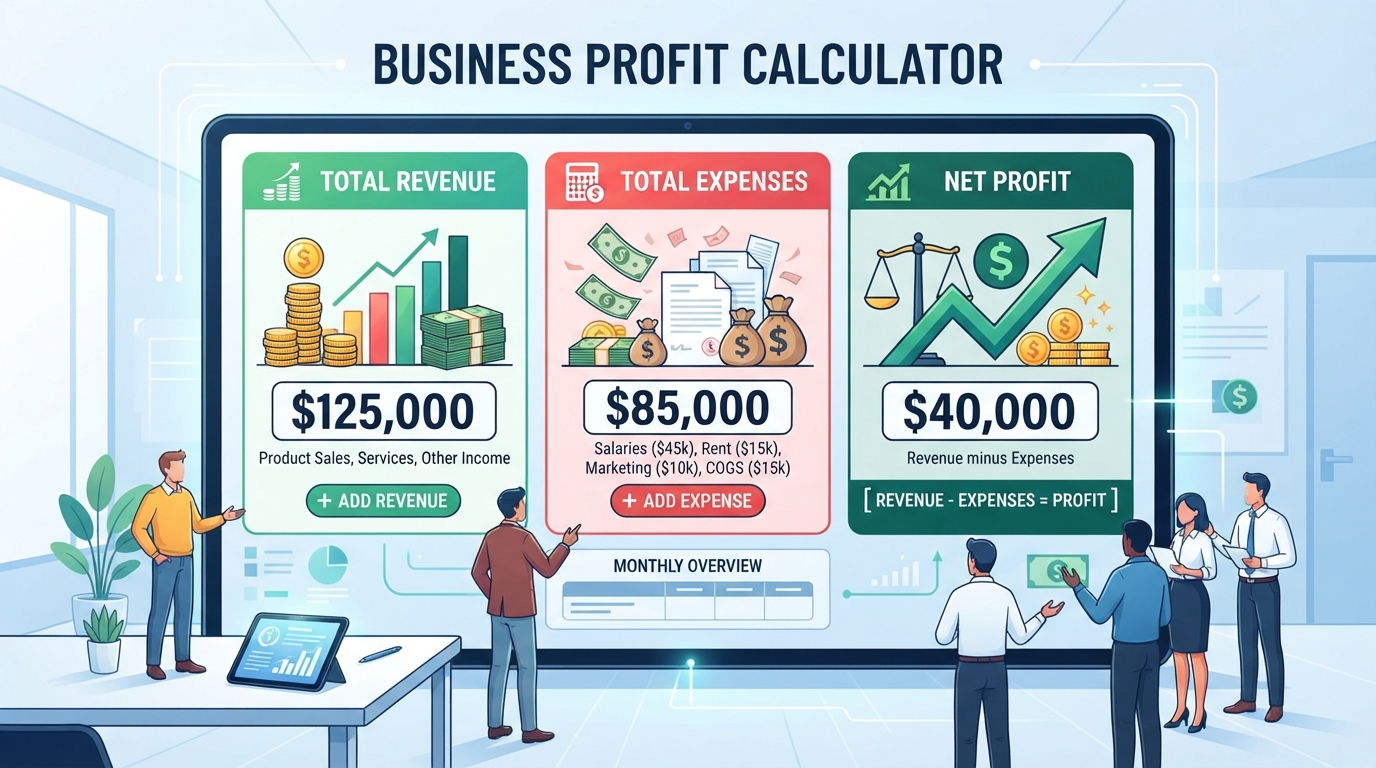
Running a business involves more than generating sales. To understand whether a business is actually making money, you need to know how much revenue it generates, how much it spends, and how much profit remains after all expenses are deducted.
A Business Profit Calculator makes this process easier by helping business owners estimate revenue, expenses, profit, and profit margin. Instead of calculating everything manually, you can enter your sales and business costs to quickly estimate your potential profit.
Whether you operate a small business, online store, service company, restaurant, freelance business, or growing company, a business profit calculator can help you understand your financial performance and make better business decisions.
What Is a Business Profit Calculator?
A Business Profit Calculator is an online financial tool that estimates how much profit a business earns after subtracting its expenses from its revenue.
The basic business profit formula is:
Profit = Revenue − Expenses
For example, if a business generates $20,000 in monthly revenue and has $14,000 in total monthly expenses:
$20,000 − $14,000 = $6,000 profit
The calculator can also help estimate the profit margin, which shows what percentage of revenue remains as profit.
The profit margin formula is:
Profit Margin = (Net Profit ÷ Revenue) × 100
Using the example above:
($6,000 ÷ $20,000) × 100 = 30%
This means the business has an estimated 30% profit margin.
Why Use a Business Profit Calculator?
Understanding profit is essential for almost every business. Sales numbers alone do not tell you whether a business is financially successful.
A company might generate high revenue but have low profit because of expensive inventory, payroll, rent, advertising, shipping, taxes, or other operating costs.
A business profit calculator can help you:
- Calculate estimated business profit
- Understand total expenses
- Estimate net income
- Calculate profit margin
- Compare revenue and costs
- Analyze pricing
- Plan business growth
- Evaluate different business scenarios
- Identify excessive expenses
- Set realistic sales targets
For small businesses and startups, these calculations can be particularly useful when planning budgets and making financial decisions.
How Does a Business Profit Calculator Work?
A typical business profit calculator uses a few basic financial inputs.
These may include:
- Total revenue
- Product or service sales
- Cost of goods sold
- Operating expenses
- Payroll
- Rent
- Marketing expenses
- Software costs
- Shipping
- Utilities
- Other business expenses
Once the information is entered, the calculator subtracts the expenses from revenue.
Basic Example
Suppose an online business has the following monthly numbers:
Revenue: $15,000
Product Costs: $5,000
Marketing: $1,500
Software: $500
Other Expenses: $1,000
Total expenses:
$5,000 + $1,500 + $500 + $1,000 = $8,000
Estimated profit:
$15,000 − $8,000 = $7,000
Estimated profit margin:
($7,000 ÷ $15,000) × 100 = 46.67%
This gives the business owner a quick overview of the estimated financial performance.
Revenue vs. Profit
One of the most important concepts for business owners to understand is the difference between revenue and profit.
What Is Revenue?
Revenue is the total amount of money a business receives from selling products or services before expenses are deducted.
For example, if a store sells 500 products for $40 each:
500 × $40 = $20,000 revenue
Revenue is sometimes called:
- Sales
- Gross sales
- Business income
- Top-line revenue
However, revenue does not represent the amount of money the business keeps.
What Is Profit?
Profit is the amount remaining after applicable business expenses are deducted from revenue.
If a business generates $20,000 in revenue and spends $14,000:
$20,000 − $14,000 = $6,000 profit
This distinction is important because a business can have high revenue but relatively low profit.
Gross Profit vs. Net Profit
A business profit calculator may calculate either gross profit, net profit, or both.
Gross Profit
Gross profit is generally calculated by subtracting the cost of goods sold from revenue.
Gross Profit = Revenue − Cost of Goods Sold
For example:
Revenue = $30,000
Cost of goods = $12,000
Gross profit = $18,000
Gross profit helps businesses understand how profitable their products or services are before many operating expenses are considered.
Net Profit
Net profit accounts for additional business expenses.
These may include:
- Payroll
- Rent
- Utilities
- Marketing
- Insurance
- Software
- Administrative expenses
- Professional services
- Other operating costs
A simplified formula is:
Net Profit = Revenue − Total Expenses
Net profit provides a broader view of the money remaining after expenses.
What Expenses Should You Include?
For a more realistic business profit calculation, include as many relevant business expenses as possible.
Cost of Goods Sold
For businesses selling physical products, this may include:
- Inventory
- Raw materials
- Packaging
- Manufacturing costs
- Product-related shipping
Employee Costs
Employee-related expenses may include:
- Salaries
- Wages
- Bonuses
- Benefits
- Payroll-related costs
Rent and Office Costs
Businesses may have expenses such as:
- Office rent
- Warehouse rent
- Utilities
- Internet
- Maintenance
- Office supplies
Marketing Expenses
Marketing costs may include:
- Google Ads
- Social media advertising
- SEO
- Content marketing
- Email marketing
- Graphic design
- Influencer marketing
Technology Expenses
Modern businesses may use multiple digital tools, including:
- Website hosting
- Software subscriptions
- CRM systems
- Accounting software
- Project management tools
- Email platforms
- Security services
Other Expenses
Depending on the business, other costs may include:
- Insurance
- Accounting
- Legal services
- Transportation
- Equipment maintenance
- Bank fees
- Professional services
Including these costs can make your estimated profit more realistic.
Business Profit Margin Calculator
Profit margin is another important metric that a business owner can calculate using business profit information.
The formula is:
Profit Margin = (Profit ÷ Revenue) × 100
For example, a company with:
Revenue = $50,000
Profit = $10,000
would have:
($10,000 ÷ $50,000) × 100 = 20%
The business has a 20% profit margin.
Profit margin allows business owners to compare profitability even when businesses have different revenue levels.
Why Profit Margin Matters
Revenue tells you how much money comes into the business, while profit margin shows how efficiently revenue is converted into profit.
For example:
Business A
Revenue: $100,000
Profit: $10,000
Profit margin: 10%
Business B
Revenue: $50,000
Profit: $10,000
Profit margin: 20%
Both businesses generate the same amount of profit, but their revenue and margins are different.
This is why looking at profit alone may not provide a complete picture of business performance.
Business Profit Calculator for Small Businesses
Small businesses often operate with limited resources, making profit calculations especially important.
A small business owner can use a profit calculator to estimate:
- Monthly profit
- Annual profit
- Profit per product
- Profit per customer
- Operating expenses
- Profit margin
- Revenue targets
For example, a local service business may generate $12,000 per month.
If monthly expenses are $7,500:
$12,000 − $7,500 = $4,500 monthly profit
Estimated annual profit:
$4,500 × 12 = $54,000
These calculations can help business owners understand their current financial position.
Business Profit Calculator for Startups
Startups often have significant initial expenses before they begin generating consistent revenue.
Startup costs may include:
- Equipment
- Website development
- Branding
- Inventory
- Business registration
- Office setup
- Software
- Advertising
- Professional services
A startup can use a business profit calculator alongside a startup cost calculator to create financial projections.
For example, an entrepreneur could create different scenarios:
Conservative Scenario
Lower sales + higher expenses
Expected Scenario
Estimated sales + expected expenses
Growth Scenario
Higher sales + increased operating costs
Comparing scenarios can help entrepreneurs understand how changes in revenue and expenses affect potential profitability.
Business Profit Calculator for Online Businesses
Online businesses have different cost structures compared with traditional businesses.
An e-commerce store may have:
- Product costs
- Payment processing fees
- Shipping
- Packaging
- Advertising
- Platform fees
- Website hosting
- Returns
A digital business may have lower inventory expenses but higher costs for software, marketing, contractors, and customer acquisition.
A business profit calculator can help online entrepreneurs estimate their actual profit after these costs.
E-commerce Profit Calculation Example
Suppose an online store generates:
Monthly Sales: $25,000
Expenses:
- Inventory: $8,000
- Advertising: $4,000
- Shipping: $2,000
- Platform fees: $1,000
- Software: $500
- Other expenses: $1,000
Total expenses:
$16,500
Estimated profit:
$25,000 − $16,500 = $8,500
Profit margin:
($8,500 ÷ $25,000) × 100 = 34%
This calculation gives the store owner a better understanding of how much money remains after major business expenses.
Business Profit Calculator for Service Businesses
Service businesses often have a different cost structure.
Examples include:
- Consulting businesses
- Marketing agencies
- SEO agencies
- Web design companies
- Cleaning services
- Accounting firms
- Freelancers
- Repair businesses
A service business may have relatively low product costs but significant expenses related to employees, contractors, software, office space, and marketing.
For example:
Revenue = $20,000
Expenses = $12,000
Profit = $8,000
Profit margin = 40%
Tracking these numbers can help service businesses determine whether their pricing is sustainable.
How to Increase Business Profit
If your calculator shows that your profit is lower than expected, there are several areas you can review.
Increase Revenue
Businesses can increase revenue through:
- Higher sales volume
- New products
- New services
- Additional customers
- Upselling
- Cross-selling
- New markets
Review Pricing
Pricing has a direct effect on revenue and profitability.
If your costs increase but prices remain unchanged, your profit margin may decline.
Businesses should regularly review pricing based on:
- Costs
- Market conditions
- Customer demand
- Competitor pricing
- Product value
Reduce Unnecessary Expenses
Review recurring costs and identify expenses that are no longer producing value.
Potential areas include:
- Unused software
- Excessive advertising
- Unnecessary subscriptions
- Inefficient suppliers
- Excess inventory
- Avoidable operational costs
Reducing expenses can increase profit without requiring additional sales.
Improve Operational Efficiency
Better processes can reduce wasted time and resources.
Businesses can improve efficiency through:
- Automation
- Better inventory management
- Employee training
- Workflow improvements
- Technology
- Supplier optimization
Profit Per Product Calculator
Businesses selling multiple products can calculate the profit generated by individual products.
For example:
Selling price = $100
Product cost = $60
Additional selling costs = $10
Profit per product:
$100 − $60 − $10 = $30
If the business sells 500 units:
$30 × 500 = $15,000 profit
This type of analysis can help businesses understand which products contribute more to overall profitability.
Monthly vs. Annual Business Profit
A business profit calculator can be used for both monthly and annual calculations.
Monthly Profit
Monthly Revenue − Monthly Expenses = Monthly Profit
Annual Profit
Annual Revenue − Annual Expenses = Annual Profit
If a business earns $8,000 profit per month:
$8,000 × 12 = $96,000 annual profit
However, businesses with seasonal revenue should avoid simply multiplying one month by 12. Instead, calculate revenue and expenses for each month when possible.
Break-Even Point and Business Profit
Profit calculations are closely related to the break-even point.
The break-even point is the level at which total revenue equals total costs.
At break-even:
Revenue = Expenses
There is no profit and no loss.
Once revenue exceeds the break-even point, the business may begin generating operating profit, depending on the costs included in the calculation.
Using a Business Profit Calculator together with a Break-Even Calculator can give business owners a more complete understanding of their financial situation.
Common Business Profit Calculation Mistakes
Ignoring Small Expenses
Small recurring expenses can add up over time.
Subscriptions, software fees, bank charges, and other minor expenses should not automatically be ignored.
Confusing Revenue With Profit
High sales do not necessarily mean high profitability.
Always subtract relevant expenses before determining profit.
Forgetting Variable Costs
Some expenses increase as sales increase.
For example:
- Shipping
- Payment processing
- Packaging
- Product costs
- Sales commissions
These variable costs should be considered when estimating profit.
Using Outdated Numbers
Business expenses and revenue can change over time.
Review your calculations regularly using current information.
Ignoring Taxes
A basic profit calculator may not account for every tax obligation. Actual after-tax income can differ from operating or accounting profit.
For important financial or tax decisions, consult a qualified financial or tax professional.
Frequently Asked Questions
What is a Business Profit Calculator?
A Business Profit Calculator is an online tool that helps estimate business profit by comparing revenue with expenses. It can also calculate profit margins and other financial metrics depending on the tool.
How do I calculate business profit?
The basic formula is:
Business Profit = Revenue − Total Expenses
For a more detailed analysis, separate costs into categories such as cost of goods sold, payroll, marketing, rent, software, shipping, and other operating expenses.
What is a good business profit margin?
There is no single profit margin that is appropriate for every business. Profit margins vary significantly by industry, business model, pricing structure, operating costs, and company size.
Does higher revenue always mean higher profit?
No. A business can increase revenue while profit remains unchanged or even decreases if expenses increase at the same time.
Can I use a profit calculator for a startup?
Yes. A startup can use a profit calculator to create different revenue and expense scenarios. It can be particularly useful when combined with startup cost and break-even calculations.
Can an online store use a Business Profit Calculator?
Yes. E-commerce businesses can include product costs, advertising, shipping, platform fees, payment processing fees, software, and other expenses to estimate potential profit.
What is the difference between gross profit and net profit?
Gross profit generally subtracts the cost of goods sold from revenue. Net profit considers a broader range of business expenses and represents the amount remaining after those expenses.
Use a Business Profit Calculator to Understand Your Numbers
Profit is one of the most important financial measurements for any business. Revenue shows how much money a company generates, but profit shows what remains after expenses are considered.
A Business Profit Calculator provides a simple way to estimate these numbers without complicated manual calculations.
By entering revenue, product costs, payroll, marketing expenses, rent, software, shipping, and other costs, business owners can estimate their profit and profit margin.
The calculator can be useful for small businesses, startups, freelancers, service providers, e-commerce stores, restaurants, agencies, retailers, and established companies.
Use your results as a planning tool, review your actual financial records regularly, and update your calculations as your business changes.